Choose screen mesh around the problem you want to solve: small insects, an interrupted view or everyday comfort. The fabric and the enclosure framing are separate decisions.
Quick Summary
Choose pool-enclosure mesh by the insects you need to exclude, then compare viewing clarity and ventilation for the exact products proposed. A general insect screen and a fine no-see-um screen serve different priorities. For Sarasota homeowners planning more cooler-season evenings on the lanai, Danny's Pools of Southwest Florida coordinates enclosure projects and discusses screen options. This guide explains how to compare samples, separate mesh choices from frame design and define a useful proposal.
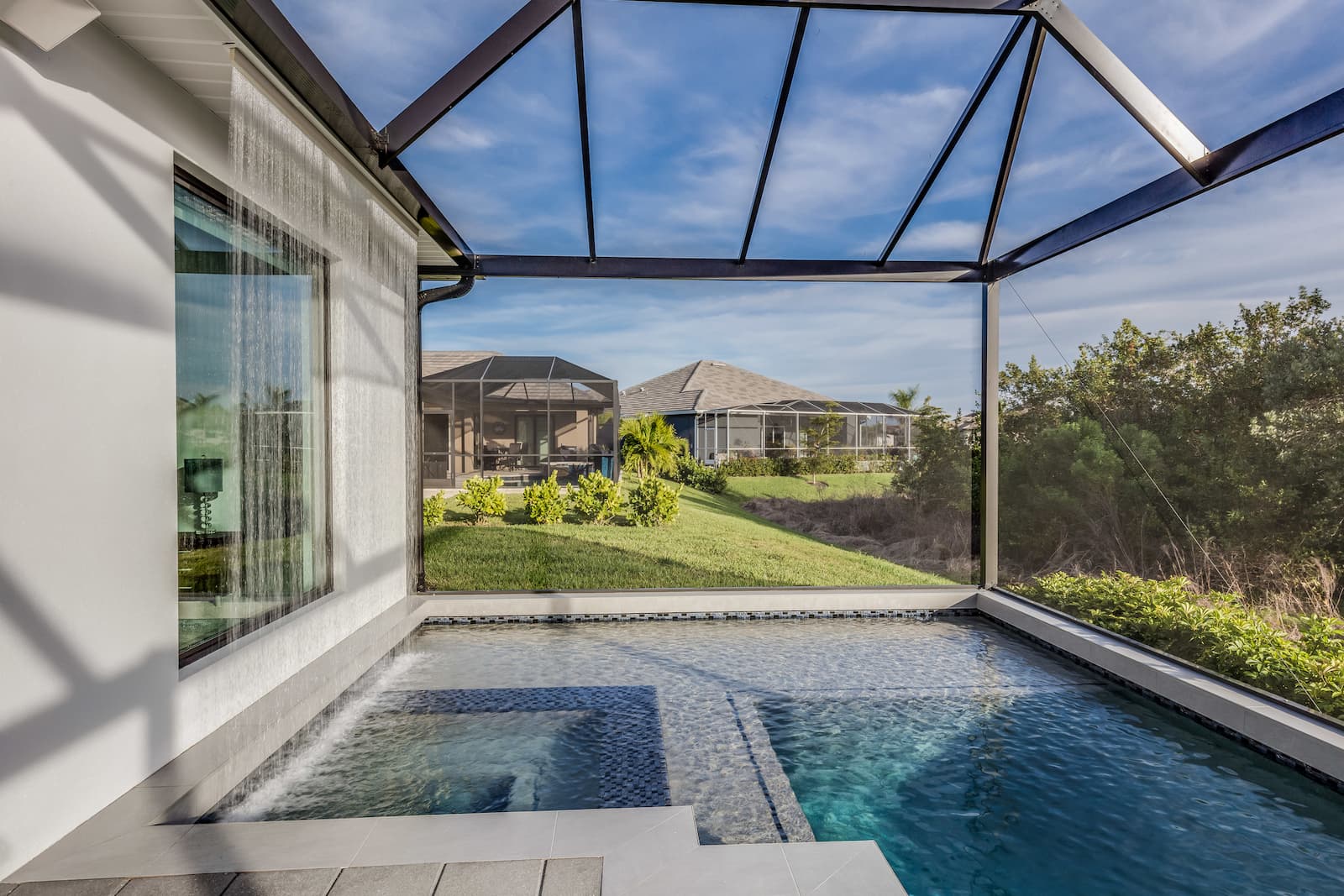
Illustrative enclosure image from Danny's Pools' service pages. A photograph shows the frame and view, but cannot establish the mesh specification or its insect-exclusion performance.
Why consider screen mesh before more evenings outdoors?
If November means more meals or quiet evenings on your lanai, judge the enclosure at those hours. A screen that seems satisfactory during a midday swim may not address the small insects you notice near sunset. UF/IFAS Extension reports that no-see-ums are generally most active around sunrise and sunset. They are most abundant in summer but can bite at any time of year.
That does not establish an insect problem at your property. Start with what you actually observe: tiny insects inside an apparently intact enclosure, insects entering near a doorway, damaged panels, or simply a view you would like to improve. Different concerns call for different conversations.
Discuss fine insect mesh when excluding very small insects is a priority. UF/IFAS explains that screen opening size matters because regular window screens do not exclude biting midges. That principle is useful when comparing enclosure fabrics: the label "insect screen" alone does not identify which insects the material is designed to exclude.
Phifer's 20x20 No-See-Um Screen card describes a tightly woven fiberglass product intended to stop most small insects, while still allowing ventilation and visibility. Treat that as a specification for a named product, not a guarantee for every material sold under a similar description or for the whole enclosure.
Ask the contractor to identify the exact manufacturer and product, then explain its small-insect claim. If you are unsure what insect you are seeing, avoid choosing a complete rescreen solely from a guess. Photographs and a description of when and where the insects appear can help focus the discussion.
Compare actual products rather than assuming that every fine screen, dark screen or premium screen performs alike. Phifer lists insect protection, airflow and viewing clarity as separate features in its selection guide. Decide which matters most at your seating area, then ask what the proposed fabric offers in each category.
For an unobtrusive view, ask to compare samples while looking toward the yard from your usual chair.
For small-insect concerns, confirm the product is specifically intended for that purpose before prioritizing a clearer-view option.
For a space that already feels still, ask for the manufacturer's ventilation information and discuss the enclosure layout.
For daytime privacy, ask what remains visible under your actual lighting conditions instead of treating mesh as an opaque wall.
Keep the comparison consistent: place the samples against the same background in similar light. A close-up photograph on a white product card does not show what you will see across the pool. Ask which tradeoff you are accepting and whether another suitable product is worth comparing.
Is a picture-view enclosure the same as clearer mesh?
No. Mesh is the fabric across an opening; a picture-view layout concerns the size and arrangement of framed openings. A clearer fabric will not remove a horizontal rail from your sightline. Likewise, fewer visible frame members do not establish that the fabric excludes tiny insects.
Danny's Pools' enclosure service describes picture-view panels, finer insect mesh and a no-chair-rail option subject to the engineered design. Discuss the frame layout and the fabric as separate parts of the proposal. Do not assume that replacing mesh also authorizes changing the structure.
Should you replace mesh before checking doors and damaged panels?
Have the existing enclosure assessed before assuming that every insect is passing through the weave. Ask the contractor to check visible tears, loose panels, door fit and gaps as well as identify the installed fabric. Finer material in one area will not close an unrelated opening elsewhere.
The resulting scope might involve selected panels, a broader rescreen, or a separate discussion about the frame. Ask what can remain and why. If changing the enclosure also affects the pool surroundings, coordinate that work with the overall renovation scope rather than assuming it is included in a mesh replacement.
What should you ask to have written into the proposal?
Request the manufacturer and product name, the areas receiving each material, the condition of the frame and doors, and the work included beyond the fabric. Ask whether any proposed substitutions will be reviewed with you and what product or workmanship terms apply to the quoted scope.
Bring your priorities in order. For example, you might place small-insect exclusion first and viewing clarity second, or prefer a clearer view where the current screening already meets your insect needs. The purpose is to select a supported combination for your lanai, not to buy the most expensive label.
About this guide: Published by Danny's Pools of Southwest Florida for Sarasota-area homeowners evaluating enclosure screen options. The company coordinates screen-enclosure projects for new and existing pool areas. Product examples explain selection criteria and do not imply a particular brand is stocked or recommended for every property.
Choose screen options for the way you use your lanai
Share your enclosure concerns with Danny's Pools, including when insects appear, where you sit and whether you want to change the frame layout. Ask which screen options fit the proposed project.
SarasotaPool Screen MeshNo-See-Um ScreensOutdoor Living
Common Questions
Frequently Asked Questions
Do not assume so. Opening size and the exact product matter. Ask for a screen specifically intended for small-insect exclusion if that is the problem you need to address.
No. Confirm the named product and its stated performance, then have doors, gaps and damaged panels assessed. The fabric specification alone does not guarantee the result for the entire enclosure.
No. Mesh clarity and the frame layout are separate choices. Any change to the framing needs to be considered as part of the enclosure design.
Ask for a plan that identifies the material proposed for each area and explains why. Any combination should suit the intended use and enclosure design; do not assume a mix of materials will automatically be appropriate.